
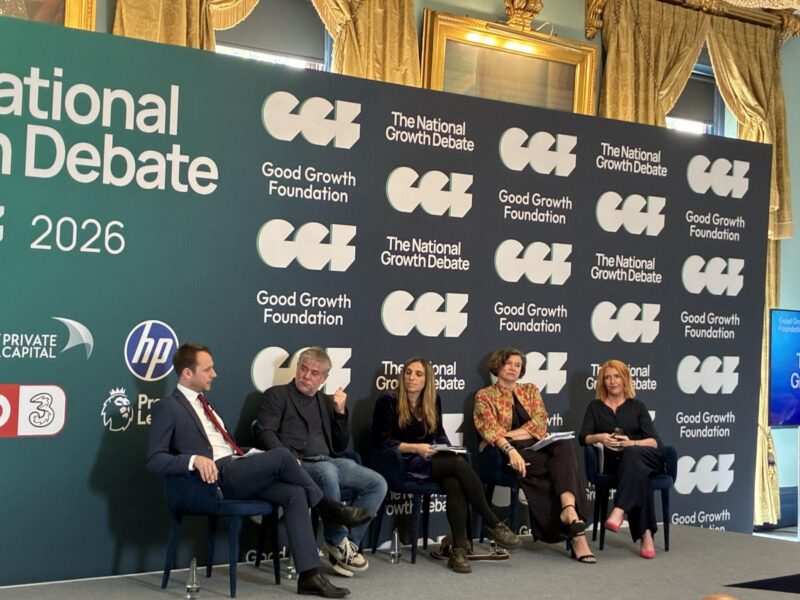
Intro
It’s fantastic to be here with so many of you –
many thanks to Praful and the team at the Good Growth Foundation for hosting such an impressive conference;
it’s fortunate it comes on such a slow news day.
But it’s a crucial debate as questions about how our economy works, and who it works for, have rarely felt more urgent.
For well over a decade, voters have been sending the same message:
that the system isn’t working, that the economy feels rigged, and that their lives are not getting better.
We saw it in the shocks that have shaped our politics since the financial crisis.
In the Scottish referendum, in Brexit, and in repeated demands for change at the ballot box.
Of course, none of us would pretend that change in the current circumstances is easy.
The Parliamentary Labour Party knows this.
Despite what the media would have you believe, we are not unruly and irresponsible.
We are united in both our diagnosis and the prescription for the economy.
We understand that the government is operating within real constraints.
Debt is now close to 100 per cent of GDP.
Borrowing costs are sky-high.
And that significantly limits room for manoeuvre.
To pretend otherwise is nothing short of deceitful.
This situation did not arise by accident.
It is the result of political decisions – particularly those of the recently-revived centrist George Osborne.
At a time when interest rates were at historic lows, he had an opportunity to invest –
to rebuild our infrastructure, strengthen our public services, and raise the productive capacity of the economy.
Instead, he inflicted austerity and entrenched short-termism.
A failure to invest alongside a massive increase in the national debt, locking Britain, as we are today, into an inflation-sensitive debt trap by issuing more inflation-linked gilts than any other major economy.
The result is the worst of all worlds.
A balance sheet under pressure, without the resilience or growth to offset it.
It is why there is no simple “tax and spend” route out of the myriad challenges we face today.
So the Chancellor has been right to focus on supply-side reform –
on planning, childcare, and energy –
and to say that welfare spending must be put on a more sustainable path.
But we should not accept that all the limits we face today are inevitable.
They are the product of political choices –
which means they can be changed.
So today I want to examine what is holding our economy back,
and set out some principles for how we begin to renew it.
The diagnosis
We know the challenges we face: weak growth,
stagnant living standards,
and an economy increasingly reliant on rising asset values rather than incomes.
But the problem is we are responding to them with one hand tied behind our backs.
Successive governments have created frameworks that have prioritised short-term consolidation over long-term growth.
From the way the OBR assesses policy,
by favouring short-term costs over long-term gains to the way the Treasury operates and
to the obsession with fiscal headroom over all other measures of economic health in our economic debate.
We have built a system that is better at managing constraint than generating prosperity –
and that is not caution, it is risk.
We cannot deliver the change people voted for if we are not prepared to change the system that is currently preventing it.
And our fiscal, tax and economic strategies must align to support the choices we wish to make.
Principles for economic renewal
Because politics is about choices.
As Labour, we must stand with those who work for their living – not those who live off wealth and assets.
I chatted the other day with a lady in Sheffield who epitomised this for me.
She works in the nearby Amazon warehouse. She’s grateful for the job but expected more.
We talked about a time when having a job in a major company like that would mean job security, less worry about bills and a few quid to enjoy the weekend with the kids.
That’s not her existence at all.
She’s worked to the bone.
Too tired to enjoy the kids and constantly feeling guilty about it.
Her husband works in another factory but has to drive for Uber at night, who are taking larger and larger chunks of his take home pay every week.
The owners of these companies don’t live in Sheffield,
they barely pay taxes in the UK,
they pay paltry wages and resist every attempt to allow ordinary workers to organise for their rights.
Our tax system is on the side of the billionaire owners of those companies whilst our neighbours who work in them feel abandoned and squeezed by the systems we govern.
We need to ask ourselves the most simple question anyone involved in politics should.
Whose side are we on?
When a single individual can accumulate more wealth in one year than thousands of working households will earn in a lifetime something is structurally wrong.
That is not success we should punish.
But it is an imbalance we must put right.
So we must reform outdated and regressive property taxes –
from Council Tax to Stamp Duty and we must address the disparities in our tax system between employment and wealth.
Next, we stand with businesses that invest, innovate and build for the long term –
not those that extract value without creating it.
This means confronting a system riddled with loopholes and cliff edges that don’t just lose revenue –
they undermine confidence and fairness in the system
It means reforming business rates and VAT thresholds to make it easier for firms to grow and take risks.
Third, we must embrace an active, strategic state –
one that supports long-term growth and economic security.
Investing in the foundations of our economy –
in energy, infrastructure, skills, and innovation –
and protecting the industries that matter for our long-term resilience.
And finally, we must reform the rules that govern our economy.
We have tied our own hands –
prioritising short-term fiscal targets over long-term growth.
That includes the way the OBR assesses policy –
focusing heavily on short-term costs, while undervaluing the long-term gains from investment and reform.
It includes a fiscal framework that places a premium on narrow measures of headroom, rather than the overall strength and resilience of the economy.
And it includes a system where the immediate cost of action is given far greater weight than the long-term cost of inaction.
We have mistaken rules for responsibility –
and until we change that, we will struggle to deliver renewal.
Reforming these frameworks is not about weakening discipline –
it is about strengthening it, by ensuring our institutions properly account for growth, investment and the long-term health of the economy.
Because this is not about abstract principles.
It is about building an economy that works for the people who rely on it every day –
workers, businesses, and communities alike.
Thank you.